
Frozen Shoulder & Hydrodistension
Insight MSK – Specialist Musculoskeletal Clinic
If you’re struggling with a frozen shoulder, you’ll know the agony all too well. The sleepless nights, the inability to find a comfortable position, and that frustrating stiffness that makes even the simplest movements impossible. I’m here to tell you there’s an effective treatment that can help.
What Is a Frozen Shoulder?
Frozen shoulder or capsulitis, to give it its proper medical name, occurs when inflammation followed by fibrosis and capsular contracture affect the connective tissue surrounding your shoulder joint. Specifically, the capsule around the glenohumeral joint (your main shoulder joint) becomes thick and tight, severely restricting movement.
Think of it this way: normally, you’ve got a loose shirt around your shoulder that allows you to move freely. With a frozen shoulder, it’s as if you’re wearing a very thick leather jacket instead. The fibres of the capsule thicken and shrink, creating adhesions that mechanically limit your mobility.

Why Does It Happen?
Honestly, we don’t fully understand why frozen shoulders develop. What we do know is that they predominantly affect middle-aged women, though men can certainly get them too. You’re more likely to develop a frozen shoulder if you’re diabetic, or following surgery or trauma to the shoulder. However, there isn’t always a clear trigger—sometimes it simply happens.

Risk Factors: Who Gets Frozen Shoulder?
Whilst frozen shoulder can affect anyone, certain groups are more susceptible. Understanding your risk factors can help you recognise the condition early and seek treatment promptly.
You’re at higher risk if you:
- Are between 40-60 years old – This is the most common age bracket, though I’ve certainly treated patients outside this range
- Are female – Women are disproportionately affected, though we don’t fully understand why
- Have diabetes – This is one of the strongest risk factors. If you’re diabetic, you’re significantly more likely to develop frozen shoulder, and it may be more severe
- Have thyroid problems – Both overactive and underactive thyroid conditions increase your risk
- Have recently had shoulder surgery or injury – Even a minor injury that’s led to prolonged immobilisation can trigger it
- Have certain other conditions – There’s an association with Dupuytren’s contracture, heart disease, and Parkinson’s disease
- Have had a stroke – Particularly affecting the same side as the stroke
The frustrating truth is that sometimes there’s no clear trigger at all. I see plenty of patients who simply wake up one day with a progressively stiffening shoulder, and we never identify a specific cause.

How Do I Know If I Have a Frozen Shoulder?
The hallmark of frozen shoulder is restricted active and passive range of motion combined with pain in the shoulder and upper arm. Here’s the key difference from other shoulder problems: with most shoulder conditions, whilst movement might be painful, if someone helps lift your arm, you can still move it through the pain. With a frozen shoulder, even if we pull your arm as hard as we can, it simply won’t move. You’re mechanically stuck in all directions.
Common symptoms include:
- Pain in the shoulder and upper arm
- Difficulty with overhead activities
- Severe pain worse at night, disrupting sleep
- Inability to reach behind your back or across your body
- Restricted movement in all directions, particularly external rotation
Night-time is particularly brutal. In the early stages, the pain is relentless—you wake up repeatedly, unable to find any comfortable position. This is actually when treatment works best, as the injection can provide significant relief when you need it most.
Is It My Neck or My Shoulder?
If your symptoms are coming from your neck, you’ll have pain but not that characteristic mechanical limitation. Your arm will still move if we force the movement—it’ll hurt, but it will move. With a frozen shoulder, it simply won’t budge.
The Three Stages of Frozen Shoulder: What to Expect
Understanding which stage you’re in helps us time treatment for maximum benefit.
This is when you’re in agony. Pain gradually worsens, often with no clear trigger. Night pain is relentless, you’re waking multiple times, unable to find any comfortable position. Movement becomes increasingly restricted as pain forces you to protect the shoulder.
This is the optimal time for treatment. The ultrasound-guided injection can provide dramatic relief when you need it most.
Paradoxically, as the shoulder becomes stiffer, the pain often lessens. You can finally sleep through the night, but you’re severely limited in what you can do. Simple tasks like putting on a coat, reaching into a back pocket, or fastening a bra become impossible. The shoulder feels “stuck.”
Treatment can still help here, particularly in breaking up adhesions and improving range of movement.
Movement gradually returns, though progress can be frustratingly slow. You might plateau for weeks, then suddenly notice improvement. Most people eventually regain full or near-full movement, though a small percentage are left with some restriction at the extreme ranges.
The total journey typically takes 12–24 months without treatment, and sometimes longer. With appropriate intervention, we can often shorten this timeline and make the journey far more bearable.
What Happens If I Don’t Treat It?
I won’t sugarcoat this, the natural course of a frozen shoulder isn’t pleasant:
- First 6 months: Severe pain, sleep disruption, inability to get comfortable in any position. You’re miserable.
- Months 6-12: The pain typically subsides, but you’re left extremely stiff. You can sleep, but you’re very limited in what you can do.
- Months 12-18+: The “thawing” phase begins. Mobility gradually returns, but you may still have some limitation at the extreme ranges of movement.
On average, without treatment, you’re looking at a good six months of pain, another six months of stiffness, and another six months of gradual recovery. Whilst most people do eventually recover fully, some are left with lingering limitations even after two years. It’s not a great prospect.
Is It Really a Frozen Shoulder? Understanding the Difference
Many shoulder conditions cause pain and restricted movement, but frozen shoulder has distinct characteristics.
With a rotator cuff tear, you’ll have weakness and pain, but the key difference is passive movement. If I lift your arm for you, it will move reasonably well—you just can’t lift it yourself due to weakness or pain. With frozen shoulder, even when I try to move your arm, it simply won’t go. You’re mechanically stuck.
Arthritis typically causes a grinding or crunching sensation, and you’ll see changes on an X-ray. The restriction pattern is different too—arthritis usually affects rotation more than elevation. With frozen shoulder, you’re restricted in all directions equally, and X-rays are typically normal (apart from possibly showing some soft tissue changes).
Neck issues can cause shoulder pain, but they won’t cause that characteristic mechanical restriction. Your arm will move if we force it (though it might hurt). You’ll also typically have neck pain or symptoms radiating down your arm in a dermatomal pattern. With frozen shoulder, the neck is fine—the problem is purely in the shoulder capsule.
Impingement causes a painful arc—there’s a specific range of movement that’s particularly painful. You might struggle to lift your arm to the side between 60-120 degrees, but once past that point, movement improves. With frozen shoulder, you’re restricted at all angles, and there’s no “painful arc”—you just can’t move.
- Severe weakness out of proportion to pain
- Visible deformity
- History of significant trauma
- Fever or feeling generally unwell
- Unexplained weight loss
- Previous history of cancer
- Progressive neurological symptoms
If any of these apply to you, you need a thorough assessment to rule out more serious pathology.
How Is It Diagnosed?
Frozen shoulder is primarily a clinical diagnosis made through careful clinical history and examination. The typical patient is middle-aged (though not always), often female, possibly diabetic, with no other red flags like a history of breast cancer.
My Assessment Process
During your appointment, I’ll conduct a comprehensive range of motion assessment. I’ll check both your active movement (what you can do yourself) and passive movement (what I can achieve by moving your arm for you). With frozen shoulder, there’s usually very little difference between the two—you’re stuck.
Specific tests I perform include:
- External rotation assessment – The first thing I check. I’ll ask you to put your elbows against your sides and open your arms. If you can’t do this, it’s a strong indicator.
- Forward flexion – How far you can raise your arm in front of you
- Abduction – Lifting your arm out to the side
- Internal rotation – Reaching behind your back
Ultrasound Examination
Capsulitis remains a clinical diagnosis but I always perform an ultrasound scan as well. This allows me to support the diagnosis and exclude alternative pathology”. In frozen shoulder, I often see:
- Thickening of the coracohumeral ligament
- A thickened inferior capsule (I compare both shoulders to assess this)
- Fluid around the long head of biceps tendon (not specific to frozen shoulder, but commonly seen in the early painful stage)
The ultrasound also helps me rule out other conditions and plan the most effective treatment approach.

Treatment Options: What Works?
Before considering injection therapy, many patients will have tried:
- Physiotherapy (though evidence suggests limited benefit in the acute painful phase)
- Oral pain medication
- Activity modification
- “Watchful waiting”
Whilst frozen shoulder will eventually resolve on its own, this typically takes 18-24 months with variable outcomes.
For patients who haven’t responded to conservative treatment, or those in significant pain, ultrasound-guided corticosteroid injection with hydrodistension offers an evidence-based solution. Studies have shown this approach can provide improved range of motion and reduced pain, particularly when performed in the early freezing stage.
For the small percentage of patients who don’t improve with injection therapy, surgical options exist:
- Manipulation under anaesthetic – The surgeon moves your shoulder to break up adhesions whilst you’re asleep
- Arthroscopic capsular release – Keyhole surgery to cut through the tight capsule
However, the vast majority of my patients respond well to injection therapy and never need surgery.
Who Should Consider Ultrasound-Guided Injection?
This treatment is particularly suitable if you:
- Are in the painful freezing stage and struggling to sleep
- Have tried conservative management (physiotherapy, oral medication) for 6-12 weeks without improvement
- Have severe pain that’s not relieved by standard painkillers
- Are significantly limited in your daily activities
- Are diabetic (we can still treat you if your HbA1c is below 8.5)
- Want an evidence-based intervention to speed your recovery

The Treatment: Hydrodistension (Hydrodilatation) with Corticosteroid Injection
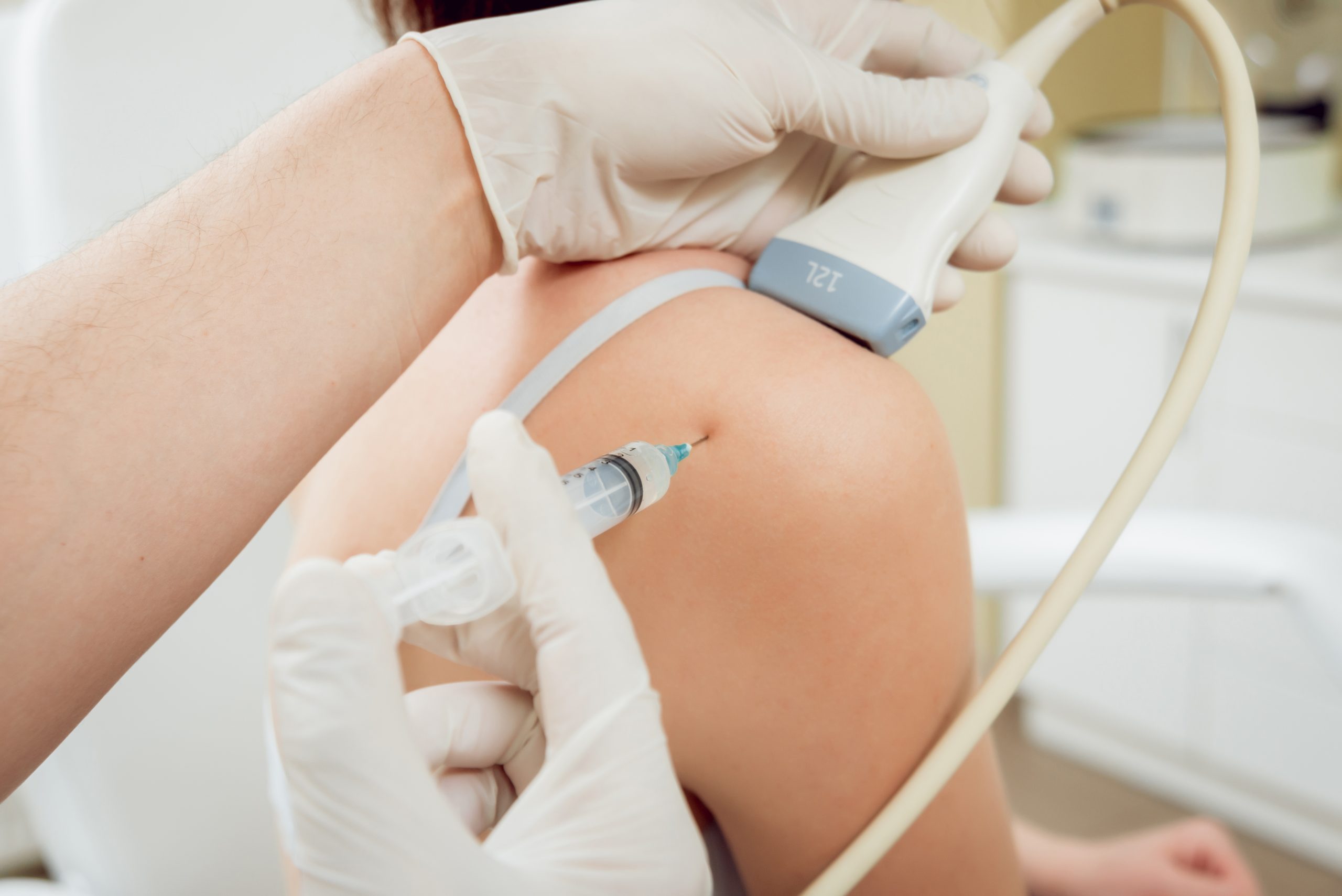
One of the most effective non-surgical treatments for frozen shoulder, particularly in the early painful stage, is an ultrasound-guided injection of corticosteroid combined with hydrodistension of the glenohumeral joint.
Here’s how it works:
- Ultrasound guidance – I use real-time ultrasound imaging to visualise the glenohumeral joint and guide the needle precisely to the right location
- Local anaesthetic – First, I numb the skin and deeper tissues with local anaesthetic, then wait 1-2 minutes for it to take full effect
- Corticosteroid injection – I inject a corticosteroid (anti-inflammatory medication) into the joint to reduce inflammation and provide pain relief
- Saline distension – I then inject 20-40 millilitres of sterile saline into the joint capsule. The fluid volume creates pressure that gently stretches the tight capsule off the head of the humerus (upper arm bone) where it has become stuck down, breaking up adhesions
The mechanism: The pressure from the fluid stretches and disrupts the tight, contracted capsule in a controlled way, helping to restore the normal volume of the joint and improve your range of motion.
Now, I’ll be honest with you: the research on hydrodistension is mixed. Some randomised controlled trials suggest it doesn’t offer significantly more than a simple steroid injection alone. However, in my practice—and I perform four or five of these procedures every week—I consistently see excellent results with decreased pain and increased shoulder motion. When I speak with other experienced clinicians, we all tend to agree. This reflects clinical experience rather than definitive long-term comparative evidence.
Here’s what I think makes the difference: sometimes during the injection, I can actually see the capsule opening up on the ultrasound as I inject the fluid. Occasionally, you can see one part of the capsule still adhering, and as I push more fluid in, there’s a ‘clack’—you can feel or even hear something mechanical happening as the adhesion releases. The research doesn’t distinguish between these cases, but I believe that’s where we see the best results.
Following an evidence-based approach whilst also drawing on extensive clinical experience, I’ve found this combination treatment to be highly effective for the right patients at the right time.
The procedure takes approximately 15-20 minutes from start to finish.
Is it painful? No. I don’t understand why people think it’s painful, to be honest. I had a patient this morning who’d had it done before and told me, “Oh, it’s horrible, it’s horrible.” Afterwards, she asked, “Have you even done something?”
The key is waiting long enough for the local anaesthetic to work. Most discomfort comes from the initial skin numbing. I always inject subcutaneous local anaesthetic first, wait a minute or two for it to take effect, and only then proceed with the actual hydrodistension.
During the injection itself, you might feel some pressure or a cooling sensation as the fluid goes in, but most patients report pressure rather than pain. Some people notice a feeling of fullness or stretching in the shoulder, which is the capsule being gently distended.
Risks are similar to those of a standard corticosteroid injection when performed under ultrasound guidance. The ultrasound visualisation ensures accuracy and safety.
If you’re diabetic: I won’t perform the injection if your HbA1c is above 8.5 (if you’re type 1 or on insulin). The corticosteroid can raise your blood sugar levels for a couple of weeks, so you’ll need to monitor this carefully and potentially adjust your medication with your diabetes team.
To make your appointment as efficient as possible, please bring:
- Any previous imaging (X-rays, MRI, or ultrasound scans of your shoulder)
- A list of your current medications
- Your recent HbA1c results if you’re diabetic
- Any referral letters from your GP or specialist
- Details of treatments you’ve already tried
Day-by-Day: Your Recovery Timeline
Here’s what to expect after your ultrasound-guided hydrodistension injection.
Take it easy. You might feel some soreness at the injection site—this is normal. The local anaesthetic will wear off within a few hours (short term), but the corticosteroid is already starting to work to reduce inflammation. Many patients report sleeping through the night for the first time in months.
What to do:
- Rest the shoulder
- You can move it gently for daily activities, but avoid heavy lifting or reaching
- Ice can help if you’re sore (15-20 minutes, several times daily)
- Take paracetamol or an NSAID medication such as ibuprofen if needed for discomfort
You should notice reduced pain. Now’s the time to start gentle movement. I’m not talking about formal exercises yet—just use your arm normally for light daily activities. Make a cup of tea, get dressed, brush your hair.
What to do: Gradually increase gentle activity. Listen to your body—some discomfort is fine, but sharp pain is a signal to ease off.
This is where we start challenging the shoulder. Remember that “heavy bucket” principle? It’s time to put some stress on that capsule. The goal is to load the shoulder in a controlled way.
What to do: Start with light weights or resistance. Think about activities that put your arm in different positions—reaching overhead, behind your back, out to the side. Swimming can be excellent if you’re comfortable.
You should have significant improvement by now. Some patients are back to normal; others still have some restriction but are vastly better than before the injection.
What to do: Keep loading the shoulder progressively. If you’ve plateaued or aren’t where you want to be, get back in touch—we can discuss whether a repeat injection would help.
Contact me if:
- Pain suddenly worsens significantly
- You develop fever or feel unwell
- The shoulder becomes hot, red, or swollen
- You’re not seeing any improvement by 4-6 weeks
- You develop new weakness or neurological symptoms
Exercises After Your Frozen Shoulder Injection
The key principle: controlled stress on the capsule. We want to challenge the shoulder without causing a major flare-up or increasing inflammation.
The First Few Days: Gentle Pendulum
Stand and lean forward, letting your affected arm hang down. Gently swing it in small circles, then back and forth. This isn’t about stretching—it’s about maintaining some movement without aggravation. Do this for 1-2 minutes, three times daily.
Week 1 Onwards: Active Movement
- Wall walks: Face a wall, walk your fingers up as high as comfortable. Hold for 5 seconds, then walk them down. Repeat 10 times.
- Door frame stretch: Stand in a doorway, place your forearm against the frame, and gently turn your body away. You should feel a stretch across the front of your shoulder. Hold 30 seconds, repeat 3 times.
- External rotation: Hold a resistance band or light weight. Keep your elbow at your side, rotate your forearm outward. This is often the stiffest movement—be patient.
Week 2 Onwards: The 'Heavy Bucket' Principle
This isn’t as mad as it sounds. Hold a bucket (or any weight—a bag of shopping works) and perform broad sweeping movements across your body—like mopping a floor. The combination of weight and movement challenges the capsule effectively. Start light (2-3kg) and gradually increase.
What to Avoid
- Aggressive stretching that causes sharp pain
- Completely immobilising the shoulder
- Exercises that cause significant pain the next day
The golden rule: Some discomfort during exercise is acceptable—it should feel like you’re working the shoulder. But sharp, severe pain is your body telling you to ease off.
Do I Need Physiotherapy?
I don’t believe physiotherapy is helpful in the very irritable, acute freezing stage and can sometimes aggravate symptoms. I’m a physiotherapist myself, and I’ve seen this first-hand. Later, once the acute pain settles, physio can help you regain strength and fine-tune your movement, but in those early weeks when you’re in agony, getting the injection is far more beneficial.
My background as a physiotherapist gives me unique insight into when manual therapy helps and when it doesn’t. In the acute freezing stage of adhesive capsulitis, attempting to force movement through physiotherapy often just aggravates the inflammation and makes you more miserable.
The injection itself is your best solution for sleeping. All those blogs about pillow positioning—they’re written by people who’ve never had a frozen shoulder. When you’re in the acute phase, you simply cannot sleep. You’re sitting up in a chair, shifting constantly, never comfortable. The ultrasound-guided corticosteroid injection changes that, often within 48-72 hours.
The expectation is that by the time the injection wears off, your condition will have improved enough that you won’t need another. However, if you’re not where you need to be, we can repeat the injection—I just ask for at least a month between treatments.
Many patients need only one injection. I rarely go beyond two injections—if you’re not responding by then, we need to reconsider the diagnosis or explore other options such as manipulation under anaesthetic.
There is a risk—around 10-15% of patients develop frozen shoulder in the opposite shoulder. I’ve even seen patients present with both shoulders affected, with the second one starting just a week after the first. It’s not common, but it does happen.
If you’ve had frozen shoulder in one shoulder, be vigilant about the other. Early recognition and treatment can make a significant difference to your experience if it does occur.
Real Patient Stories
“I couldn’t sleep for three months. I’d tried everything, different pillows, sleeping in a chair, nothing worked. I was exhausted and miserable. I had the injection on a Tuesday, and by Thursday night, I slept six hours straight. It was life-changing. Yes, I still needed to do the exercises, and it took a few months to get full movement back, but just being able to sleep made everything manageable.”
“I’d had minor shoulder surgery for an old cycling injury. Six weeks later, my shoulder just froze up. My surgeon said it sometimes happens. I was stuck in that frozen stage, couldn’t reach my back pocket, couldn’t put on a jacket properly. The hydrodistension made an immediate difference to the stiffness. I actually heard something ‘pop’ during the procedure—not painful, just odd. Within a fortnight, I had about 60% more movement.”
“Mine just appeared out of nowhere. One day, fine. Two months later, I couldn’t lift my arm. I’d been told to ‘wait it out’ that it would resolve in two years. Two years! I couldn’t face that. After the injection, the severe pain settled within days. I’m not going to pretend I was perfect immediately, I still had stiffness—but I went from being unable to function to getting my life back.”
“This is the nightmare scenario, isn’t it? I got one frozen shoulder, then the other started eight months later. I had injections in both, at different times obviously. The first one taught me not to waita, as soon as the second shoulder started playing up, I was straight on the phone. Early treatment definitely made the second one easier to manage.”
Frequently Asked Questions About Frozen Shoulder & Hydrodistension
It’s uncommon for frozen shoulder to recur in the same shoulder. However, there’s a 10-15% chance of developing it in the opposite shoulder. Some unlucky souls get both, though rarely at the same time.
You shouldn’t drive on the day of the injection due to the local anaesthetic. After that, it depends on your comfort and control. If you can perform an emergency stop without hesitation, you’re probably fine. Check with your insurance if you’re uncertain.
For desk jobs, most patients return within 2-3 days. For manual work, it depends on the demands of your role. We can discuss this at your appointment and provide any documentation your employer needs.
After the initial 2-day rest period, gradually return to activities as comfort allows. Swimming is often excellent—the water supports your arm whilst allowing movement. Golf might take longer due to the rotation required. Gym work is fine, but modify exercises in the early weeks. Listen to your shoulder.
Very rarely. The vast majority of patients respond well to ultrasound-guided injection, with or without physiotherapy. Surgery—either manipulation under anaesthesia or arthroscopic capsular release—is reserved for the small percentage who don’t improve with conservative measures.
Many patients need only one. If we haven’t achieved sufficient improvement after 4-6 weeks, we can consider a repeat injection (leaving at least a month between treatments). I rarely go beyond two injections—if you’re not responding by then, we need to reconsider the diagnosis or explore other options.
Studies suggest that a majority of patients experience meaningful improvement, particularly in pain and function.. In my clinical experience performing 4-5 of these procedures weekly, the success rate feels higher—but then, the patients who do well might not always report back. In my experience, most patients derive at least some benefit..
If you’ve had no improvement after 6-8 weeks, we’ll reassess. Sometimes the diagnosis needs revisiting—could something else be contributing? Occasionally, patients need a different approach, such as manipulation under anaesthesia or arthroscopic capsular release. We’ll discuss all options.
Your initial consultation and treatment appointment typically takes 45-60 minutes. This includes time for clinical assessment, ultrasound examination, the injection procedure itself (15-20 minutes), and post-procedure advice.
Should I Wait or Act Now?
Many patients try to “wait it out” or persist with physiotherapy that’s simply making them more miserable. My view? If you’re in the acute painful phase, don’t waste time. Physiotherapy is often poorly tolerated when the shoulder is this irritable.. Get the ultrasound-guided injection, get some relief, and start your recovery properly.
The research may not always reflect what we see in clinical practice, but following an evidence-based approach combined with extensive clinical experience, I’ve yet to find a patient who hasn’t found this treatment helpful to at least some degree. The combination of ultrasound guidance, corticosteroid anti-inflammatory effect, and mechanical capsular distension offers the best chance of improved range of motion and reduced pain.
What Happens Next?
If you’re experiencing the symptoms I’ve described—especially that characteristic restriction of both active and passive range of motion combined with severe pain—it’s worth getting assessed. Ideally, you’ll have already had an X-ray or ultrasound scan showing adhesive capsulitis, but I can perform the ultrasound examination during your appointment if needed.
The key is not to suffer unnecessarily. Frozen shoulder will eventually resolve on its own, but that’s 18 months to 2 years of your life significantly impacted. With effective ultrasound-guided treatment, we can make that journey much more bearable and potentially speed up your recovery.
What to expect at your appointment:
- 1Detailed clinical history and discussion of your symptoms
- 2Comprehensive range of motion assessment (active and passive movement testing)
- 3Ultrasound examination of the shoulder joint
- 4Discussion of findings and treatment options
- 5Ultrasound-guided injection procedure (if appropriate)
- 6Post-procedure advice and exercise guidance
- 7Follow-up planning
Book an appointment
Book your frozen shoulder assessment today and find out if ultrasound-guided treatment can relieve your pain and restore movement.


